The December call.
It is a Tuesday in the second week of December. Harvest wrapped up six weeks ago. You are working through end-of-season invoices when your phone rings. It is a loss adjuster, assigned to a customer's multi-peril crop insurance claim. Corn yield on one of his tracts came in short. His Approved Insurance Provider needs delivery records that tie specific loads to Home Place — FSA Farm 4823, Tract 7741, Field 2, Wood County.
You pull up the scale tickets from October. The customer hauled on twelve separate days, sometimes two loads before noon and two more after. He farms three fields across two tracts. Your tickets show the date, ticket number, his name, corn, gross and tare weights, moisture. They do not show which field the load came from. The free-text line on your ticket form says "Home Farm" on some of them — written in pencil, his handwriting, meaning something different depending on which day he filled it out.
What field-level documentation actually requires.
The documentation problem at the elevator has a few distinct failure modes:
- Free-text field names do not map to FSA. "South 80," "Home Farm," and "River Ground" are meaningful to the farmer and useless to an adjuster. They do not appear on the FSA-578. A loss adjuster cannot reconcile delivery weight against an insured unit based on a handwritten note.
- Multi-field harvest days leave no trail. In October, a farmer with three tracts might haul loads from two different fields in the same afternoon. Without field selection on the delivery form, those loads are indistinguishable in the records.
- Reconstruction after the fact is error-prone. Memory fades. The farmer thinks he started Tract 7741 on the 14th; his combine's GPS log says the 13th. Six weeks out, that ambiguity is hard to close without contemporaneous records.
Elevators are not required to collect FSA field identifiers. There is no regulatory mandate. The farmer's FSA records were always "the farmer's problem," and the elevator's traditional obligation ended at net weight and moisture. But crop insurance participation in corn and soybean counties across Wisconsin, Iowa, Minnesota, and Illinois now exceeds 80% of planted acres. The documentation need is not going away, and elevators that capture it are becoming the ones farmers trust.
How Horizon Grain handles it.
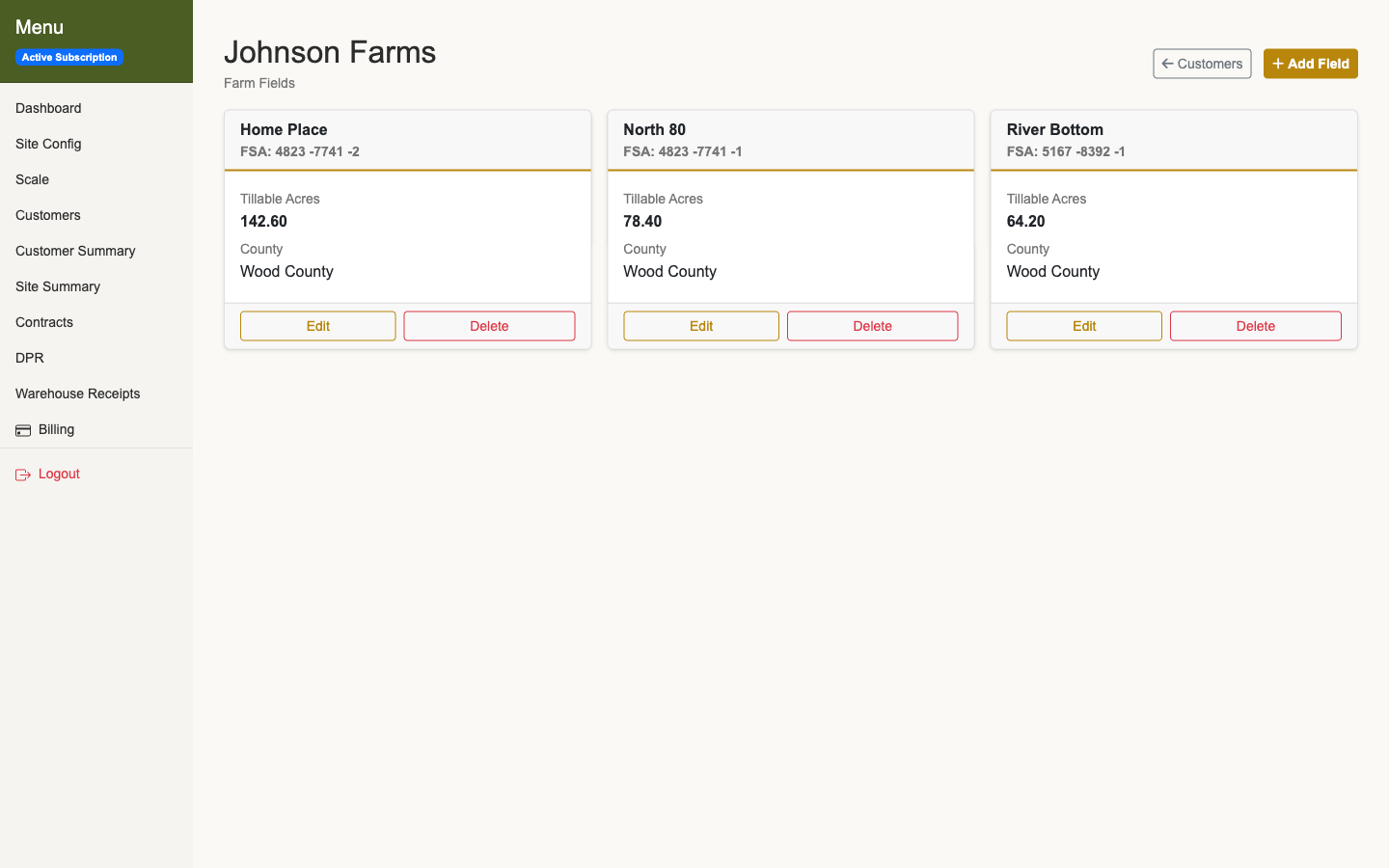
Farm field management in Horizon Grain starts on the customer profile. For each customer, you can define as many fields as they farm — each one carrying an FSA Farm Number, Tract Number, Field Number, tillable acres, and county.
When a delivery comes in, the operator picks the field from a dropdown on the delivery entry form. That selection travels with the ticket — it appears on the settlement receipt the farmer gets when he drives off the scale. The documentation exists at the moment of weighing. Not reconstructed six weeks later. Not dependent on anyone's memory of which truck was on which field on a Tuesday in October.
The adjuster's question — which loads came from Tract 7741? — is answered on every ticket the farmer received, not reconstructed from memory.
How to use it: a quick walkthrough.
- Define the fields on the customer profile. On the Customers page, click Fields on the customer’s card and add each field the customer farms with the FSA identifiers. A customer with three tracts gets three field records. Easiest to do before harvest when the farmer can read the numbers off his paperwork.
- Select the field on delivery entry. When a load comes in, the field selector appears on the delivery form alongside the standard weight and moisture fields. The operator picks the field — "Farm 4823 / Tract 7741 / Field 1, Wood Co." — from the dropdown. If the farmer is unsure or the load is a mix, the field can be left blank; capture what you can.
- The field prints on the settlement ticket. The receipt the farmer gets at the scale includes the field name and FSA identifiers alongside the standard weight, moisture, and net bushel data. The farmer can verify it on the spot. Any correction happens then — not in December.
- At claim time, the records are already complete. Every settlement ticket already carries its field name, FSA Farm-Tract-Field, and county. The substantiation is on the tickets, not in someone's notebook.
Why this matters more at small elevators.
Reconstructing field-level records after the fact takes things a two- or three-person elevator generally does not have on hand: field boundary data in a system of your own, and somebody with the time to match it back to delivery timestamps months later. If it was not captured at the scale, it usually cannot be recovered at all.
Field capture at weigh-in closes the documentation gap with zero added workload. The operator is already entering the ticket. Picking a field from a dropdown is one extra step.
Step by step: Farm fields in the user guide.